10 Essential Tools Every Mechanical Engineer Should Have
Mechanical engineers are the architects of the physical world, designing and creating the machines and systems that drive our modern society. Whether you're a seasoned professional or a student just starting your engineering journey, having the right tools at your disposal is essential for success. Here, we'll explore ten essential tools that every mechanical engineer should have in their toolkit.
2023-09-12

1. Calipers: Precision is the name of the game in mechanical engineering, and calipers are the go-to tool for measuring distances, thicknesses, and diameters with high accuracy. Digital calipers provide quick and easy readings, while vernier calipers are a more traditional but equally reliable option.
2. Micrometer: When it comes to measuring extremely fine tolerances, micrometers are the tool of choice. They are perfect for measuring dimensions such as the thickness of materials, outer and inner diameters of cylindrical objects, and depth measurements.
3. Screwdrivers and Wrenches: A set of high-quality screwdrivers and wrenches is a must for any mechanical engineer. They come in various sizes and types to handle a wide range of fasteners, from screws and bolts to nuts and hexagonal fittings.
4. Power Tools: Power tools like electric drills, grinders, and impact drivers are essential for cutting, drilling, and shaping materials efficiently. They save time and effort and are invaluable for both prototyping and manufacturing processes.
5. Multimeter: Electrical and electronic components are often an integral part of mechanical systems. A multimeter allows you to measure voltage, current, resistance, and continuity, making it a vital tool for troubleshooting and maintenance.
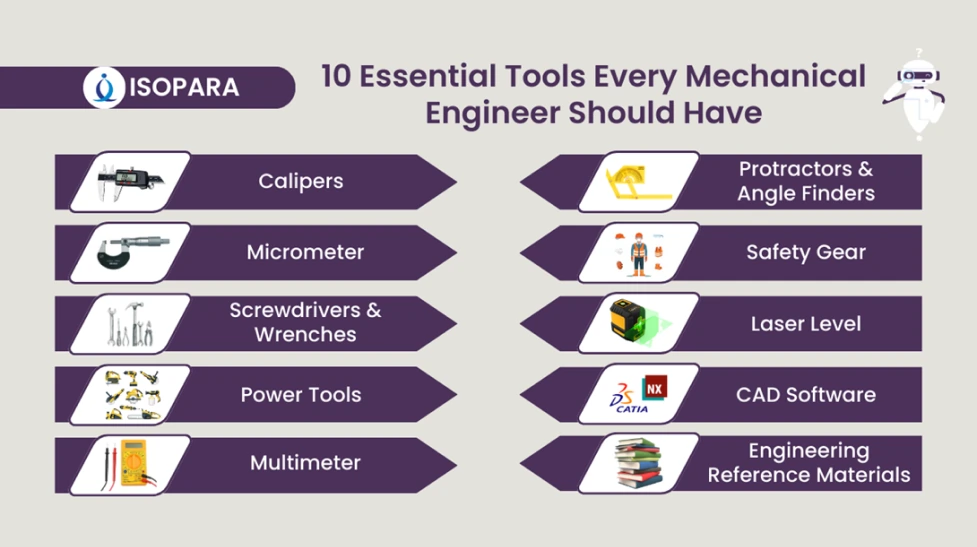
6. Protractors and Angle Finders: When working with angles and geometric designs, protractors and angle finders help you achieve precision in your measurements and constructions. They are crucial for tasks like aligning components or verifying the accuracy of mechanical systems.
7. Safety Gear: Safety should always be a top priority for mechanical engineers. Essential safety gear includes gloves, safety glasses, ear protection, and appropriate footwear. Depending on your specific work environment, you may also need additional safety equipment such as helmets or respirators.
8. Laser Level: Laser levels are handy for aligning and leveling objects over longer distances with high accuracy. They are particularly useful for setting up equipment, ensuring that surfaces are perfectly horizontal or vertical.
9. CAD Software: In the digital age, computer-aided design (CAD) software is an indispensable tool for mechanical engineers. Programs like AutoCAD, SolidWorks, and CATIA allow engineers to create 2D and 3D models, simulate designs, and perform complex calculations, streamlining the design and prototyping process.
10. Engineering Reference Materials: Last but not least, a library of engineering reference materials, such as textbooks, handbooks, and design guides, is essential for keeping your knowledge up-to-date and for solving complex engineering problems. Online resources and access to engineering databases can also be invaluable.
These ten essential tools are the foundation of a mechanical engineer's toolkit. Whether you are a student just starting your engineering journey or a seasoned professional, having these tools at your disposal will help you achieve precision, efficiency, and safety in your work. Investing in high-quality versions of these tools is a wise choice, as they will serve you well throughout your career and enable you to tackle a wide range of mechanical engineering challenges with confidence.
Author

Vikaram Patil ( Design Engineer - Tool)
Total 4 Blogs viewPress tool designer now working as free lancer and earning more than a job
Author’s journey so far:
My story begins in a tool room where I worked with CNC machines cutting press tools and dies. It was a fine time until one day, a new face appeared in the company. He carried a laptop bag and was showing designs to the owner. That was my first encounter with the world of design software like CATIA, and it sparked something inside me - a dream to pursue a career in press tool designing. I turned to my friends and seniors for guidance, but they couldn\'t provide a clear answer on how to learn PressTool design. So, one night, I turned to the internet to explore and stumbled upon Isopara. The very next day, I dialed Isopara\'s number and had a chat with Prashant Sir. He gave me a step-by-step plan on how to turn my dream into reality. But, with a job to keep and courses to complete, I opted for an online course. Believe it or not, after just three months of dedicating three hours every evening to learning, right after my job, I achieved what seemed impossible - landing my first job as a design engineer in PressTool.
Course done and recommended by Author:
Share This Page



Other Trending Videos
- 3-Steps || Choose the Right CAD Software with the Right Domain
- Roadmap || Become an Automotive Design Engineer in BIW Domain.
- Roadmap || Become an Automotive Design Engineer in Plastic Domain
- Not Getting Interview CALLS? || Career Guidance
- Mechanical Design Jobs || Domain Skill
- Why CAD and its Importance? || By Experts
- Difference || CAD Engineer Vs Design Engineer
- Best CAD Software to Learn & Build a Career || By Experts
- Best CAD Software to Learn || Most Demanded by Industries
- How to Become a Design Engineer? || By Expert.